The Pines At The End Of The Road
A Short Story

(Note: I uploaded this story as an audio file for those who are interested, but don’t have time to read it. I’m quite happy with the reading, which was created with some fancy software. Would it have been better to read it myself? Let me know in the comments.)
I recently learned about a fiction writing exercise where you use a short story by an author you admire as a template or outline for one of your own. One of my favorite authors has always been John Steinbeck (of course), and for this exercise I used his story, “The Chrysanthemums,” which can be found in his book, “The Long Valley.” It’s a fantastic collection of short stories that I highly recommend.
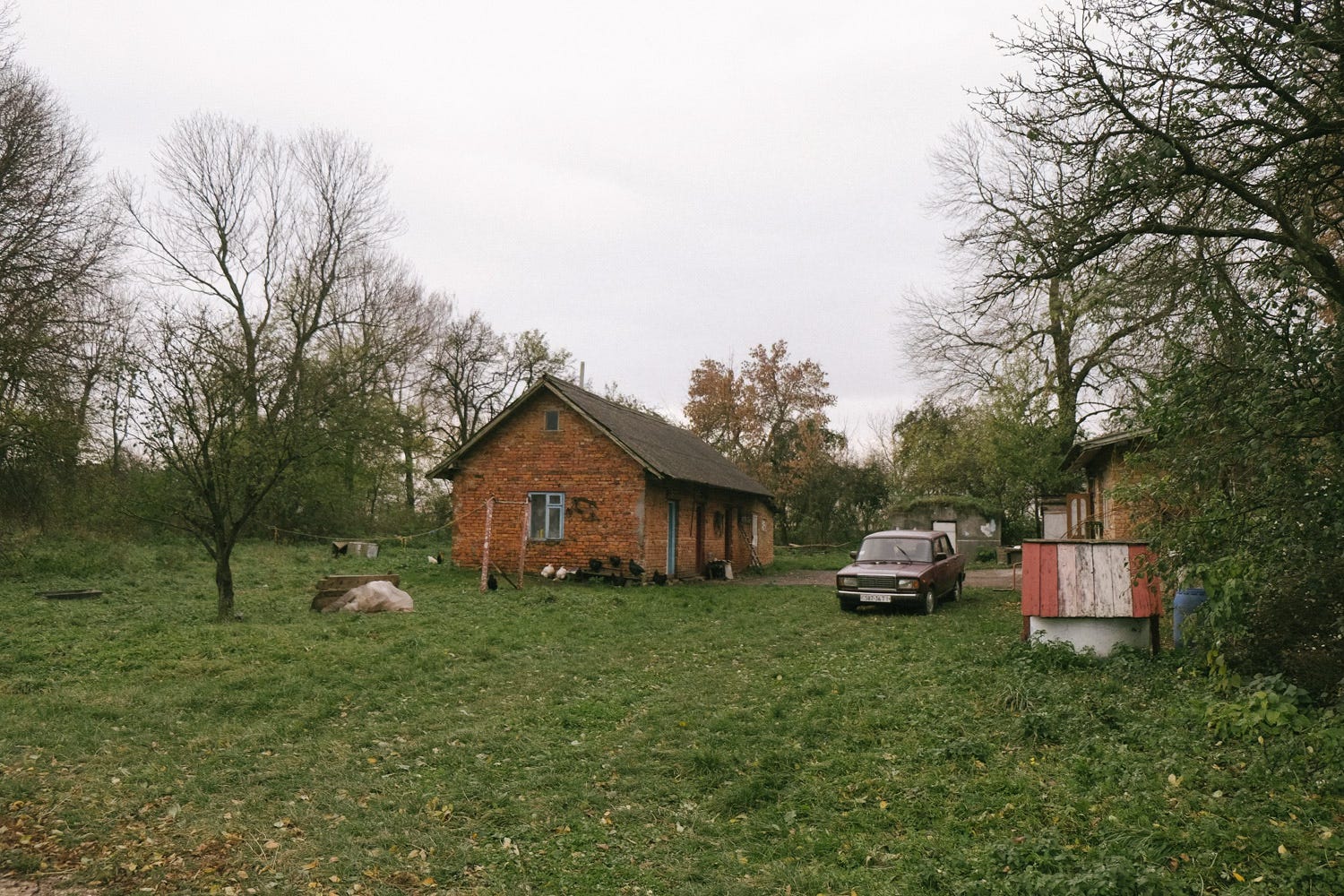
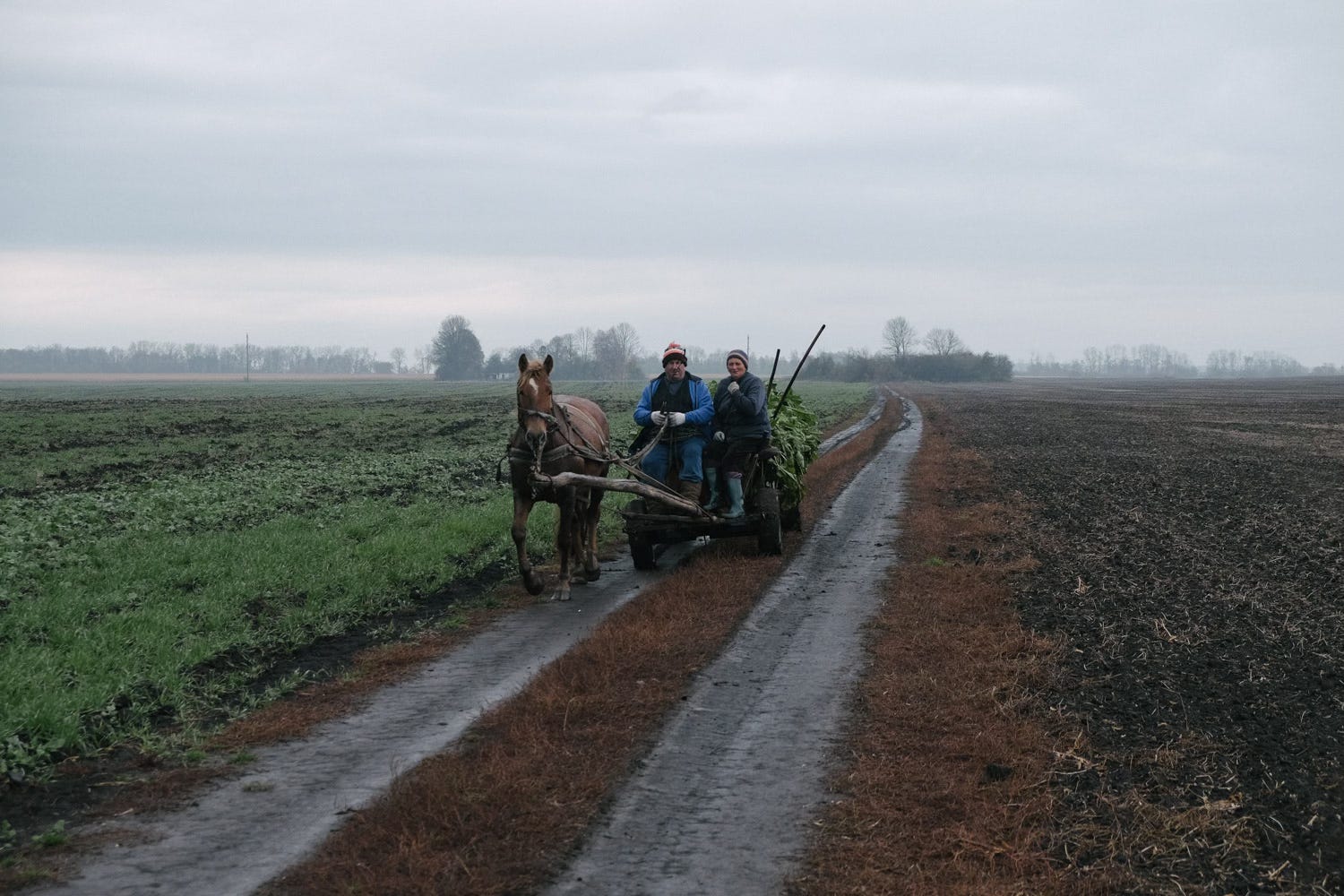
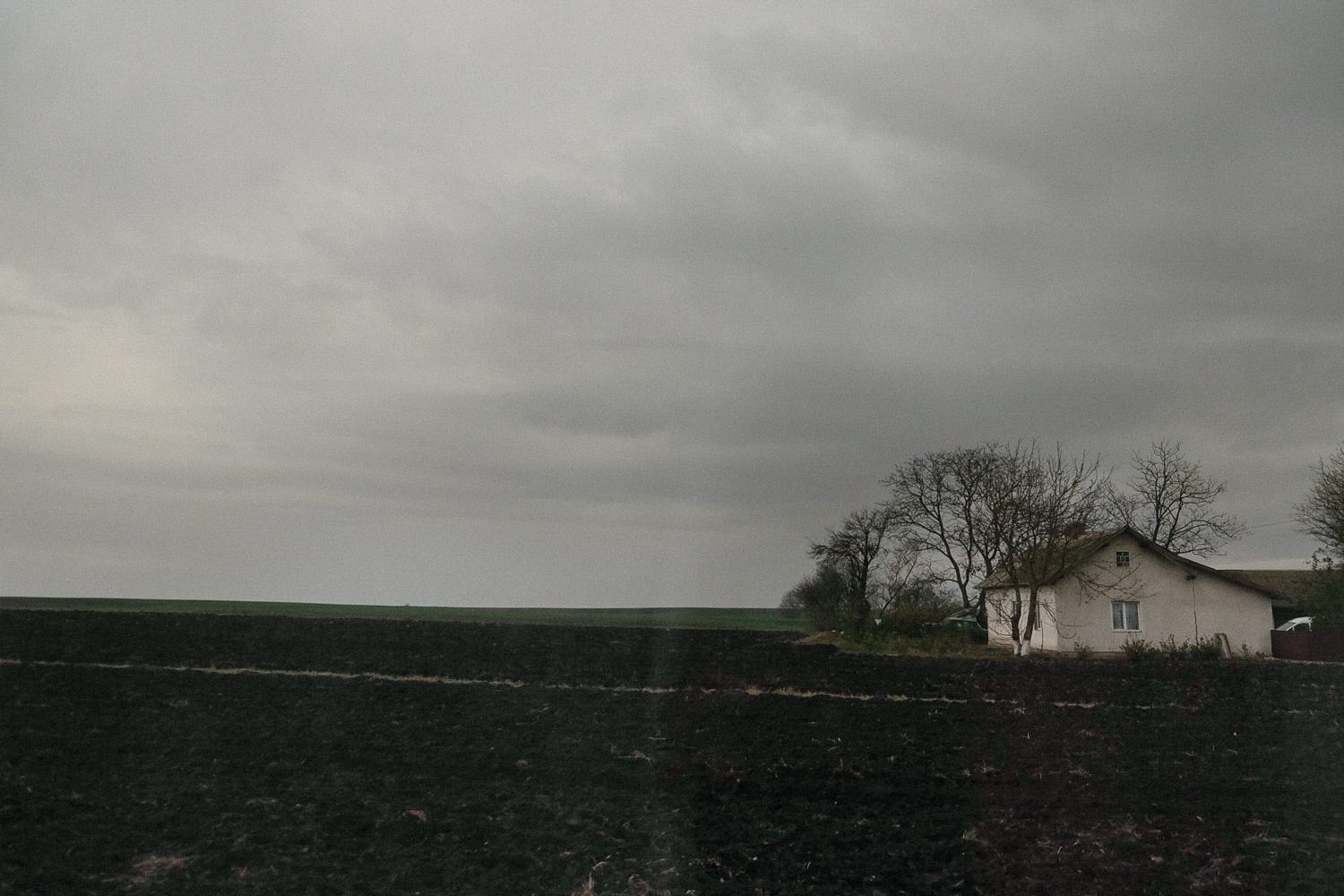
My story is based on impressions from time spent on my wife’s family farm in western Ukraine, as well as from stories that she told me about her time growing up there. It’s a place that feels far removed from the rest of the world. Where time seems to have stopped 50 years ago (or a few hundred years ago, depending on where you’re looking). It’s a place that’s typically silent aside from the whisper of the wind, and where animals wander freely and safely down the middle of the road. Time spent out there provides me with a deep well of sensations and impressions to draw upon as I continue with my writing journey. I hope you enjoy.
Anna’s knife knocked against the wet, wooden cutting board, drawing thin, dark lines in the aged wood. Without looking, she pushed aside a pile of apple wedges, then reached for a fresh apple to slice, using her fingers to line up the blade with the stem. Her eyes lingered on the window above the counter as she worked. She did not daydream, she just observed. Nothing much happened in the village, but if something did she would not risk missing it. Beyond the dirty glass, and beyond the apple trees in the yard, the late autumn sun burned over dry fields of wheat. On the stove next to Anna a five-gallon aluminum pot billowed steam, and condensation dripped silently down the window pane. It gave her a funny feeling to watch a sunny afternoon behind what looked like rain on the glass. But the only time the windows in the kitchen weren’t foggy and wet was during a mid-summer day when a hot wind blew through the open door and the steam disappeared as soon as it rose from the pot.
The pile of quartered green apples was now large enough to fill half the pot. Juice from the apples stung the small cuts on her hands, even though her hands were strong and tough. Every morning, she shuffled through the garden, bent double at the waist, her tough hands scouring the ground under the vines, seeking a gourd, or some herb that was ready to be pulled, and she never wore gloves. Her fingernails were black underneath. Even a long wash at the spigot was never enough to get them clean. It didn’t bother her. She didn’t need clean hands except on Sunday. Her grandmother was the one who cooked for the family. Mostly she just cooked for Churchill. She’d cooked for him since he was a tiny pink thing, wrinkled and squealing and fat.
Her eyes returned inside to the apples, and she smiled and spoke to herself. Her voice was high and gentle, like a sweet whisper. “You’re going to love these, Churchill. Apples like these I haven’t seen in a long time. Definitely didn’t get any like this last year.” She hummed a little melody, then wanting to taste the apple juice that clung to her finger, she placed it on her tongue. Her eyes tightened into a squint and her cheeks puckered like she was blowing a kiss to a stranger beyond the window. But no one was there. The village was mostly empty now, everyone having died or moved away.
“Sour, just like you like them,” she coughed. “Sour like your mood this morning.” She laughed and shook her head and blinked the tears out of her eyes, and at the same time turned in the direction of Churchill where he lay waiting in his pen on the other side of the wall.
“Now for your potatoes,” she said, as she reached down and grabbed two in each hand and placed them on the wet counter. The dirt on the thick brown skins turned instantly to mud and ran down the counter to the wall where it formed a puddle. She picked up a new knife, this one smaller and sharper, with a waterlogged wooden handle, it’s blade having been sharpened so many times it now bowed like a scimitar. By feel only, she pulled the blade toward her thumb, removing the skin of the first potato in one long ribbon that draped all the way to the floor before it fell from the blade. “These, my big baby, are not as exciting as the apples, but you will need them. Plus I went to the hard work of pulling a new sack of them out of the cellar just for you.”
Anna felt a deep satisfaction as she looked at the potatoes and apples piled on the counter. This food was of the earth, and in it she saw the seasons and the weather and life and all the treasures that the land gave. The black under her nails was black earth far more valuable than money. That black earth sustained their bodies, and it sustained their spirit. Outside, where long deep lines lay cut into the black fields arcing over the low hill behind the house, was where she’d come to learn what a gift it was to live on these lands. In those fields she’d learned to cautiously tread barefoot among the rows of delicate green shoots, the shoots that would grow and nurture them, just like she would grow and nurture Churchill. Anna’s love for Churchill overflowed from her into her chores and responsibilities on the farm. But to Anna, it was not work if it was for Churchill.
She dropped the apples and the potatoes into the pot and jumped back to avoid getting splashed by boiling water. Next came the five handfuls of buckwheat that would hold the mush together once it all cooked down.
When it was all in she placed the lid on top, gripping the thin, bent handle with a dirty rag, and leaving just a small crack at the side for the steam to escape. She stepped back and examined her hands. The skin was wrinkled on the fingers, and especially on the tips, where it was pruned and pink and tender from the acidic apple juice. That soft tender skin made her think of Churchill when he was so small she could hold him in one hand if she wanted, and he would squeal and blink his long eyelashes as he stared into her eyes. Even then, he knew his existence had been entrusted to her. As he grew his eyes only seemed to probe deeper into her very being. It didn’t take long before his eyes and his face were the same size as hers, and then she looked back into the depths of his being as well, and in those moments she knew that their bond was as great as mother and son. And she knew that should one of them die the other would carry their spirit by the simple fact of their continued existence.
She watched the pot to make sure the simmer was just right, then she picked up the pail holding the apple cores and potato skins, and walked out into the fading light. She turned to face the sun where it sank behind the grove of pines on the far side of the field. She let the golden light enter her eyes, and without blinking she let it’s warmth sink into her mind. A few stray hairs flickered across her face and as they passed across her vision the hairs appeared huge, beyond all reasonable proportion. Heavy white bars that seemed to hold her in place where she stood. With the back of her hand, where the skin was still clean and dry, she wiped the hairs away, and she was free to move again. Free to feel the sun for a moment longer and acknowledge that another day had almost passed.
The compost heap lay on the far side of the chicken coop. As she approached, the cocker spaniel lunged out from the shadows thinking the pail she carried contained his dinner. He sprinted toward her, barking wildly, and if she didn’t know better she would have thought he was going to tear into her legs. He reached the end of his chain and when it caught him by the collar on his neck he flipped over backward, crying out in pain and disappointment before cowering back into his doghouse, his tail between his legs. There he sulked, only his snout and eyes visible in the tiny, dark doorway, but she could tell by how they shook that his tail still wagged. She assured him she’d be back soon then skirted the perimeter of his chain where his paws had worn a deep semicircle in the dirt.
She emptied the pail onto the heap, and as she did she thought about how good the dirt would be when the scraps broke down and she could shovel it out from the bottom and spread it through the garden. She loved to think about how all the scraps from her bucket made the best dirt. As long as she only added the vegetable scraps and nothing else, the rats stayed off it, and the dirt came out black and rich, almost oily in its richness.
***
A flicker of movement caught her eye as she passed the barn on the way back to the kitchen, and she looked up to see a man at the end of the drive. He stood next to his wagon, which was still hitched to his horse. The horse stamped a front hoof, snorted, and shook it’s head. The man whispered something in its ear, then ran his hands along its mane. The horse now stood quietly, its shoulder muscles quivering, resigned to wait.
She recognized the man. He lived across the bridge at the far side of the village. His house was on the outskirts, and as a young girl she’d played in his apple orchard. Only a few of those trees still stood, but the ones that did produced some of the best apples in the village. In the back of his wagon lay a few lumpy woolen sacks, and she guessed it was those apples that lay inside.
She waved and said hello, her other hand held like a visor above her eyes to shield them from the final rays of sun as it dropped behind the trees. The man removed his heavy woolen fedora, and the remaining wisps of gray hair underneath blew sideways across his head. His smile was warm, and even though he could have been her grandfather she saw him as dashing and handsome. He stooped slightly, but his hands and arms were strong. His eyes were kind and gentle and radiated a peace that can only come from living a life where minutes and hours mean little, and the shortening and lengthening of days is the true measure of time. She liked strong men with kind eyes, and as he stood there in front of her she felt safe. Looking closer she saw the deep lines that ran between his eyes, the result of a lifetime of difficult decisions. Possibly the hardest of all being the decision to stay in the village, the crying wind his only company, his sons having left years ago. His wife rested in the black earth under the pines at the end of the road. As she watched him he turned in that direction and sighed.
Turning back to her he asked, “Where’s Churchill?”
“In his pen,” Anna said. “I was just on my way to check on him now. His dinner is on the stove.”
“Is your grandmother home?”
“Not yet. She should be on her way back, but the roads are muddy and the car is slow.”
“Did she tell you I was coming?”
“I was sleeping when she left.”
The man nodded. “How about we go in and you can make me a cup of tea while we wait for her to get home?”
“Do you want to move your horse and wagon first?”
“Nobody is coming down the road today.”
“Okay.”
***
He sat patiently while she placed an aluminum kettle and two tea cups on the table. Anna poured Carpathian tea into the cups and handed one to the man. His large calloused finger wouldn’t fit through the delicate handle, so he held the cup by the rim and slurped noisily until the level was below his fingers and it wouldn’t burn him.
The pale and cloudless sky occupied the windows in the sitting room. From the table where they sat the space beyond the glass felt vast and profoundly empty. A wooden icon of Jesus hung between the windows and to Anna he seemed a part of that vastness, suspended in the cold sky. The vastness used to scare her when she was little, but now it brought her peace. In this room earth seemed not to exist. Only space existed here. Her mind found solace in this room. It was a place where words were unnecessary, and she sat without saying anything, and the man understood. He stared out the window and sipped his tea while she watched him.
Gravel crunched in the drive as the car pulled in.
“I hope my horse didn’t get in their way.”
“They probably went around the back.”
“I better go talk to your grandmother.”
“That’s okay. I need to check on Churchill’s food.”
The man looked at her and didn’t say anything. His mouth opened to speak, but he closed it again. He stood and walked out of the room, patting her gently on the back as he passed. Outside the doorway he turned back and thanked her for the tea. She smiled at him, and without saying anything just swung a leg back and forth under the chair.
After he left she gathered the teapot and the cups on the tray, and left the main house for the kitchen which stood alone on the other side of the courtyard. When she got halfway across she glanced over and saw the man talking in hushed tones to her grandmother and her uncle. The man’s head turned toward Churchill’s pen, and then his arm and hand followed, his finger wagging as he talked. She felt her breath catch in her chest for a moment, and she turned and walked into the kitchen, the sighing wind the only sound reaching her ears.
In the kitchen she stared at the pot of food on the stove but her eye’s did not really see it. She only saw the man’s face and his outstretched hand. Her heart beat faster in her chest, and she walked to the window, stood on her toes, and pressed her face against the glass to see what they were doing. The driveway was empty.
A loud crash resounded behind the wall on the far side of the kitchen—the wall that separated the kitchen from Churchill’s pen. She spun and faced the cracked white paint, her eyes boring into it as if they might penetrate it and see right through. Another loud thump, and then Churchill squealed, his screeching voice clearly audible through the wall. Anna raised a hand to her mouth. Churchill squealed again, and then came a loud murmur of voices, but she could not make out the words. She felt her lips begin to quiver, and tears welled in her eyes until they overflowed and dripped down her cheeks onto her shirt. She wiped her face with her sleeve and backed across the room, never once taking her eyes off the wall, until she reached the chair at the far side where she sat. The room was silent now, but she could hear her own heart pounding inside her head.
Churchill screamed again, and a door slammed. Anna pressed her back against the wall and felt its rough coolness against her spine. She remembered when, two years ago, another man had come to their farm and the same sounds had come from that room. Even though it was only two years earlier she’d been a much younger girl, and hadn’t known what those sounds meant at first. But the pig had screamed and gasped for hours as she sat in the kitchen desperately trying to focus her mind on something else, until the screaming stopped and she knew without a doubt that he was dead. Her heart never hardened to that memory, even after her grandmother assured her it was a natural part of life on the farm, and that one day she would understand. Once the terrible noise had subsided and some hours had passed, during which she’d sat in a chair hugging her knees and rocking back and forth, she’d gone out and seen the other man sitting at the well. A bucket sat at his feet. It was full of long ugly bones and ears and cloven hooves, which he rinsed one by one under the spigot before laying them on the ground where they sat, bleached and alien looking. It was raining that day, and under the cold gray skies blood ran down the driveway until it fanned out by the front gate into a wide pattern like red lace and finally mixed with the grass in the ditch at the side of the road. All that afternoon she had stared at that blood mixing with rainwater on the drive until it faded to pink and finally ran clear again, and she didn’t see the rains the same for months afterward.
Anna looked at the pot of food on the stove, and her chest heaved uncontrollably and she wept. She rested her forehead in her hands and the tears spilled out and fell on the front of her shirt until it was wet and stuck to her skin. She felt that cold wetness and it reminded her of the cold rains on that autumn day two years before. Her stomach muscles knotted and ached as she sobbed, and the coldness sank deeper into her heart. She reached out a hand and felt for the warmth of the pot on the stove beside her. She held her hand there until that heat began to restore life down her arm and back into her chest.
The door to the kitchen opened and she saw the blue light of dusk behind the outline of the man in the doorway.
“Why are you crying, girl?” he asked.
She looked at him with blood red eyes, but couldn’t bring herself to speak. She wanted to speak for Churchill, but knew her words meant nothing to the man and her uncle. She only stared, her lips quivering, her thoughts like a tangle of thorns.
The man’s eyes traveled to the pot on the stove, then to the cracked white wall on the far side of the room. He looked back at Anna and said, “I’m sure he’s hungry. Why don’t you go ahead and take him his dinner.”
Anna sat up and her mouth opened to speak, but no words came out.
“Don’t just stare at me. He’s a jumpy one, but we didn’t hurt him. He’s a valuable stud and he needed an examination before he does his work in a few months. You take good care of him, you hear, and I’ll come back and check in on him again soon.” The man crossed the room and lightly touched the handles of the pot, testing to see if they were still too hot to touch. When they didn’t burn, he grasped them and lifted the heavy pot from the stove. “Come on, I’ll carry it over there for you.”
She smoothed the front of her shirt and followed him out of the kitchen, passing her grandmother and her uncle who both looked at her without expression. They rounded the corner of the kitchen building, and with his foot the man pushed open the heavy red wooden door to Churchill’s stall. As they entered Churchill smelled the mush and raised his great mass from the mud and shuffled to the edge of the pen, his giant wet nose snorting all the time. A small lamp on the wall cast a faint warm light across the pen. Anna reached out her hand to touch his nose and his rough tongue lapped up at her fingers. She did not mind that it was sticky and muddy. He nibbled her hand and continued snorting, and his huge eyes blinked and looked at her with trust and love.
“You go on and give it to him,” the man said. “I better be going.” He set the pot down on the hard earthen floor and walked back outside, stooping to fit beneath the low doorframe. She turned away from Churchill to see his silhouette fade into the darkness outside. She stepped to the door of the pen and watched as he walked to the end of the driveway. He waved to her grandmother and uncle as he passed the kitchen building, then he climbed onto the rough wooden seat of the wagon and rode off toward the pines at the end of the road.